Conditions › Lower Limb › Flat Feet
Lower LimbFlat Feet (Fallen Arches)
When the arch of the foot collapses or sits lower than normal, the effects often don't stop at the foot — they can ripple all the way up to the knees, hips and lower back.
Conditions › Lower Limb › Flat Feet
Lower LimbWhen the arch of the foot collapses or sits lower than normal, the effects often don't stop at the foot — they can ripple all the way up to the knees, hips and lower back.
Flat feet occur when the arch of the foot collapses or sits lower than normal, causing more (or all) of the sole to make contact with the ground. The arch normally acts as a natural shock absorber and lever for walking — when it doesn't hold its shape properly, the altered mechanics can affect not just the foot, but the ankle, knee, hip and lower back above it.
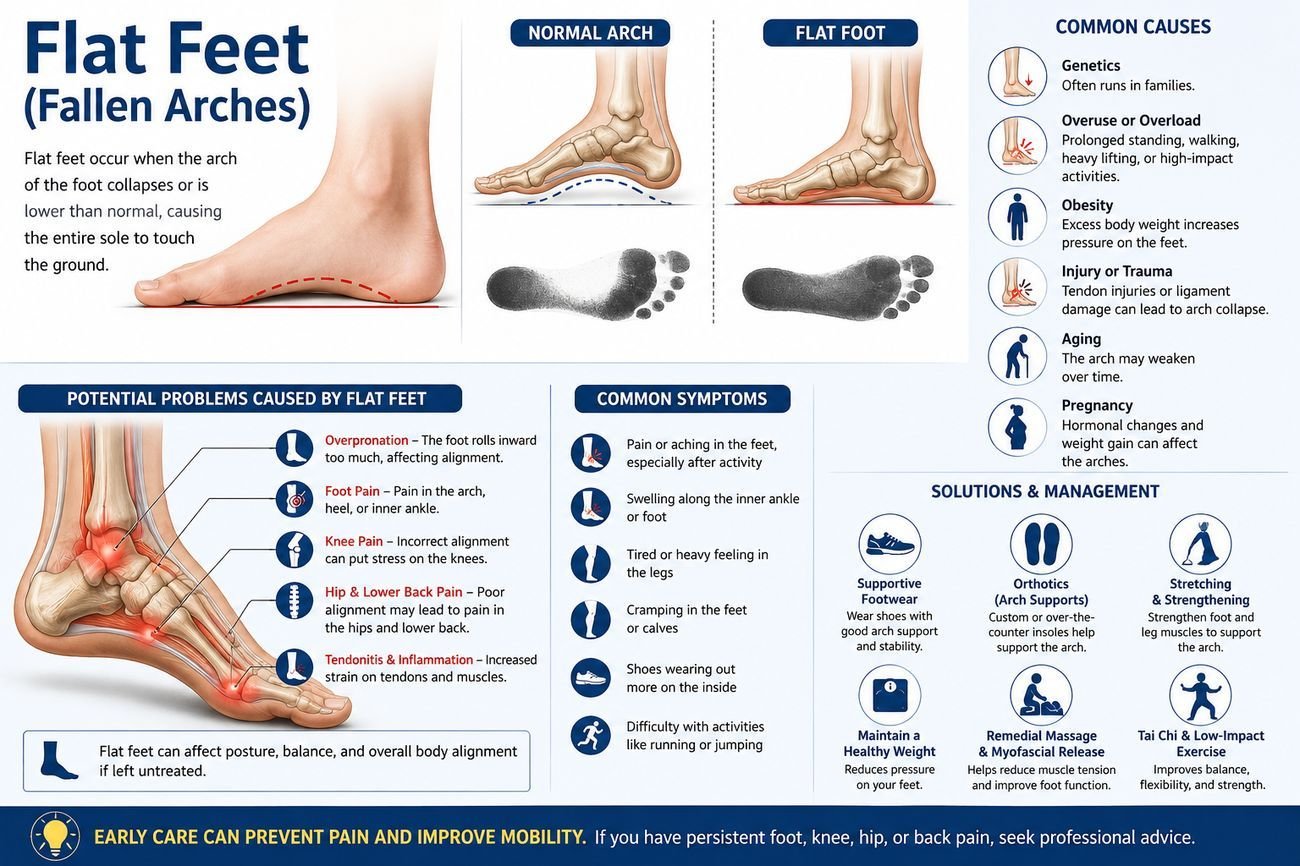
The arch relies on a combination of bone shape, ligaments and tendons working together; when any part underperforms, the arch can gradually flatten.
A flattened arch commonly causes the foot to roll inward excessively during walking, altering alignment up the whole leg.
Altered foot mechanics can change how load travels through the knees, hips and lower back, sometimes contributing to pain in those areas.
The posterior tibial tendon, which helps support the arch, is commonly strained in people with progressive flat feet.
Uneven shoe wear, particularly on the inner edge, is a simple and telling sign of altered foot mechanics.
Not everyone with flat feet experiences pain — presence of symptoms depends on individual mechanics, activity level and muscle support.
The arch of the foot is closely associated with the Spleen and Kidney meridians in Traditional Chinese Medicine — the Spleen traditionally linked to muscular support and the Kidney to structural strength. A weakened or collapsed arch is traditionally understood as a sign that these systems need support, alongside local stagnation in the foot itself.
The inner ankle is the origin point of the Kidney meridian in Traditional Chinese Medicine, with the Spleen meridian also passing through this region. Persistent burning or numbness here is traditionally understood as stagnation along these pathways, sometimes alongside deeper energy depletion.
Acupressure points traditionally used for foot and arch support include KD1 (Yongquan), SP6 (Sanyinjiao) and GB40 (Qiuxu). DDS Bioelectrical Therapy is often a helpful complement for circulation and recovery in the feet — however, please tell us before your session if you have a pacemaker or any implanted electronic device, metal implants near the treatment area, are pregnant, or have epilepsy, as this therapy is not suitable in these cases.
No — many people have flat feet with no symptoms at all. Whether pain develops depends on individual mechanics, activity levels, footwear, and how well the surrounding muscles compensate.
Massage can't change the structure of the arch itself, but it can help manage the muscular tightness and compensatory tension that often develops in the feet, calves and beyond — usually alongside orthotics or supportive footwear.
Many people with symptomatic flat feet benefit from supportive footwear or custom orthotics — a podiatrist can advise on what's appropriate for you specifically.
Yes, altered foot mechanics can change how load travels up through the leg and spine, which is a recognised contributing factor for some people's knee, hip or lower back pain.
No, though they're related — flat feet is a structural pattern that can be a contributing cause of plantar fasciitis, rather than the same condition itself.
Yes, specific foot and calf strengthening exercises can help some people build better support around the arch, though they won't change the underlying bone structure.
Genetics is a recognised factor — flat feet often run in families.
Flat feet are very common and often normal in young children as arches develop — persistent concerns are best discussed with a doctor or podiatrist.
It may help with compensatory muscular tightness in the calves and feet, as part of a broader management plan.
If you need orthotics, have progressive pain, or a structural assessment of your foot mechanics, a podiatrist is the right first point of call — we're glad to work alongside their recommendations.
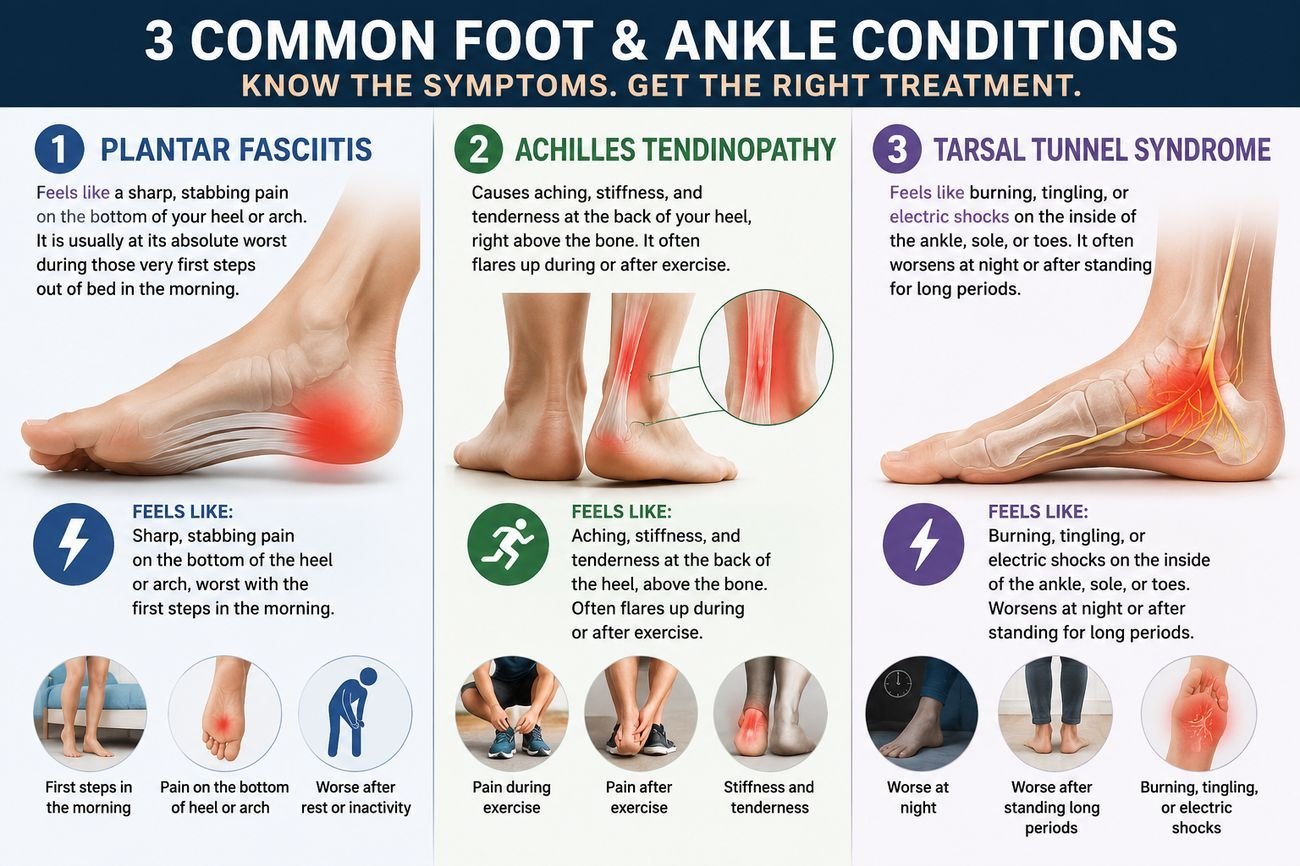
Flat feet can contribute to several other foot and heel conditions by altering how load travels through your foot. If you're experiencing sharp heel pain or burning/tingling sensations alongside your flat feet, one of these may be part of the picture too:
Shoes with good arch support and stability reduce strain on the whole lower limb.
Custom or over-the-counter insoles can provide targeted arch support.
Regular foot and calf exercises help build supportive strength around the arch.
Reducing excess load through the feet can ease associated discomfort.
Build up high-impact activity gradually rather than all at once.
This page is general education, not a diagnosis. If anything above applies to you, please see a doctor or podiatrist rather than booking a massage.