Visual Reference
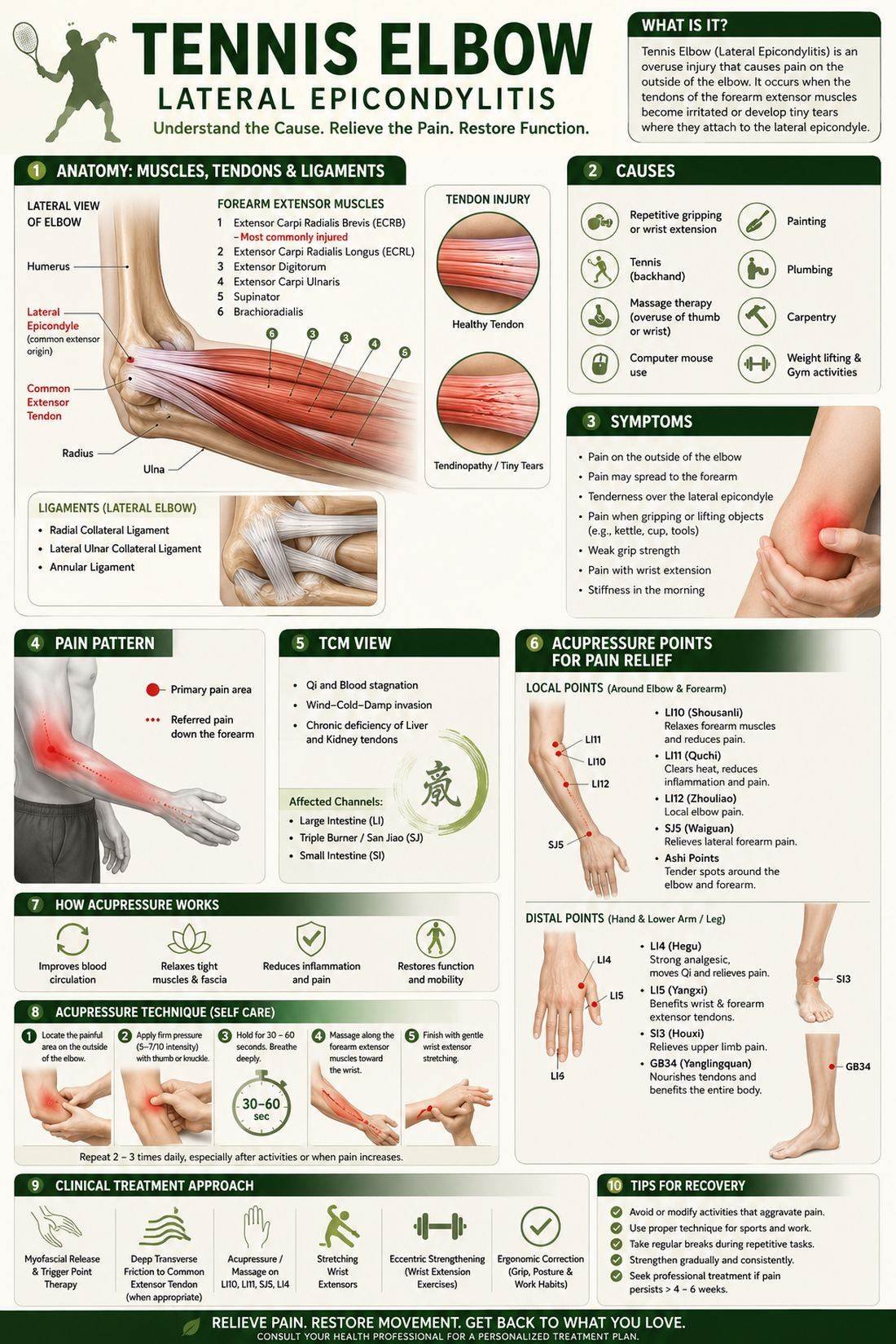
Anatomy, causes, acupressure points & self-care at a glance
Conditions › Upper Limb › Tennis Elbow
Upper LimbYou don't need to play tennis to get tennis elbow — repetitive gripping is usually the real cause.
Tennis elbow (lateral epicondylitis) involves irritation of the tendons that attach the forearm muscles to the bony bump on the outside of the elbow. These muscles extend the wrist and fingers, so any activity involving repetitive gripping or wrist extension can gradually overload this attachment point.
The common extensor tendon at the elbow is the primary structure involved in this condition.
Repetitive load causes small-scale changes within the tendon rather than acute inflammation alone.
Weakness often develops as the body protectively limits force through the irritated tendon.
Tightness throughout the forearm extensors is commonly found alongside the tendon irritation.
In some cases, a nearby nerve can contribute to symptoms, which is why thorough assessment matters.
Tendons adapt slowly to new loads, which is why gradual loading is central to recovery.
Traditional Chinese Medicine associates the outer elbow and forearm with the Large Intestine meridian, which runs directly through this region. Persistent strain here is traditionally understood as a stagnation of Qi and Blood along this pathway.
No — the vast majority of cases come from repetitive gripping or computer use, not sport.
Many clients find release of the forearm muscles helpful alongside a gradual loading exercise plan.
Complete rest isn't usually recommended — modifying aggravating activities while staying otherwise active tends to work better.
This varies, but it's often a slower-resolving condition, sometimes taking several months of consistent management.
It can help release tight forearm muscles contributing to the tendon strain.
Some people find a counterforce brace helpful for reducing load during aggravating activities.
Without addressing the underlying load and muscle tightness, it can persist — early management helps.
Rarely, and only after conservative management hasn't helped over an extended period — a decision for a specialist.
Often yes, with modifications to reduce repetitive gripping where possible.
Gradual, guided strengthening of the forearm tends to be the most evidence-supported long-term strategy.
Reduce repetitive gripping activities temporarily.
Wrist extensor stretches, held gently, can ease tightness.
Light, progressive strengthening supports tendon recovery over time.
Icing after aggravating activity can help manage discomfort.
Check your grip size and technique for repetitive tasks or sports.
This page is general education, not a diagnosis. If anything above applies to you, please see a doctor or visit an emergency department rather than booking a massage.