Conditions › Spine & Nerves › Sciatica
Spine & NervesSciatica
Why does lower back pain sometimes travel all the way down your leg? That's the sciatic nerve at work.
Conditions › Spine & Nerves › Sciatica
Spine & NervesWhy does lower back pain sometimes travel all the way down your leg? That's the sciatic nerve at work.
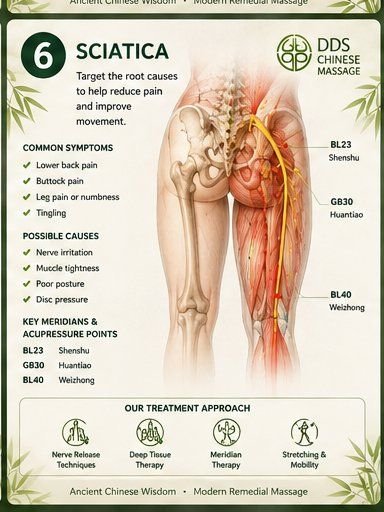
Sciatica describes pain that travels along the path of the sciatic nerve — from the lower back, through the buttock, and down the back of the leg. It's typically caused by irritation or compression of the nerve roots in the lower spine, or sometimes by tight muscles (such as the piriformis) that the nerve passes through.
The longest nerve in the body can become irritated at its origin in the lower spine or along its path through the buttock.
In some cases, a disc bulge can press on a nerve root, contributing to sciatic symptoms.
This deep buttock muscle can compress the sciatic nerve when tight, a pattern sometimes called piriformis syndrome.
Nerves need to glide smoothly through surrounding tissue; restriction in this glide can contribute to symptoms.
Local inflammation around an irritated nerve root can intensify symptoms.
Distinguishing muscular referred pain from true nerve compression is an important part of assessment.
Traditional Chinese Medicine associates the pathway of sciatic pain closely with the Bladder and Gallbladder meridians, which run along the exact route the sciatic nerve follows down the back of the leg. Stagnation along these channels is traditionally understood to produce this travelling pain pattern.
No — sciatica specifically involves nerve pain travelling down the leg, while general lower back pain stays localised to the back.
Many clients find relief from treatment targeting tight muscles that may be compressing the nerve, such as the piriformis, alongside broader lower back work.
This distinction often requires proper assessment and sometimes imaging — please see your doctor if symptoms are significant or persistent.
Generally yes, with appropriate technique, but let your therapist know about any numbness or weakness so they can adjust their approach.
Certain gentle nerve-gliding exercises can help, but aggressive stretching isn't always appropriate — professional guidance matters here.
This varies widely by cause, from a few weeks for muscular irritation to longer for disc-related cases.
Yes, prolonged sitting is one of the most common contributing factors, particularly with poor posture.
It may help release tightness in muscles like the piriformis that can contribute to nerve compression.
In a minority of persistent, severe cases with significant nerve compression, yes — this is a decision made with a specialist, not something massage can determine.
If you experience numbness in the groin area, or loss of bladder or bowel control, seek emergency care immediately — see our red flags below.
Gentle walking often helps more than prolonged rest.
Gentle piriformis and hamstring stretches may ease nerve irritation, done carefully.
Avoid prolonged sitting; stand and move every 30 minutes where possible.
Sleeping with a pillow between the knees can ease pressure on the lower back and hip.
Supportive seating that maintains the natural curve of your lower back helps reduce strain.
This page is general education, not a diagnosis. If anything above applies to you, please see a doctor or visit an emergency department rather than booking a massage.